Tindaya Project

Mount Tindaya is located on Fuerteventura in the Canary Islands. It was chosen by artist Eduardo Chillida, after a long and exhaustive search, as the location for a large-scale sculpture, a carved space of roughly cubic proportions (50m per side) inside the mountain that would be capped by two skylights.The three-phase project (I-feasibility, II-drilling, III-construction) is expected to be completed in 2015

The Roden Crater Project


"I wanted to use the very fine qualities of light. First of all, moonlight. There's a space where you can see your shadow from the light of Venus alone—things like this. I also wanted to gather starlight that was from outside the planetary system, which would be from the sun or reflected off of the moon or a planet...you've got this older light that's away from the light even of our galaxy. So that is light that would be at least three and a half billion years old. So you're gathering light that's older than our solar system."

Pepsi Pavillion

E.A.T.'s ambition was to create a laboratory environment, encouraging ‹live programming› that offered opportunity for experimentation, rather than resort to fixed or ‹dead programming›, typical of most exposition pavilions. The Pavilion‘s interior dome –immersing viewers in three-dimensional real images generated by mirror reflections, as well as spatialized electronic music–invited the spectator to individually and collectively participate in the experience.The pavilion also emits thick vapour, three decades before the blur-building.

Waw an Namus

Waw an Namus is an exotic volcano deep in the desert of Libya. A low caldera about 4 km in diameter is surrounded by a 5 - 10 km wide dark black deposit of ash that stands out starkly against the yellowish desert. The few people who have visited have been struck by its beauty: The Italian geologist Angelo Pesce wrote that as seen from the rim, one is "overwhelmed by a scene of rare beauty....Inside, the only thing one wishess is to be alone and wander in admiration from one end to the other."

Casa del Puente

An elegant single-story exposed concrete house in the seaside town of Mar del Plata, it was built in 1942 by Amancio Williams for his father. Supported by a sweeping arch over a stream, the house was innovative for its free plan, fenestration and daring use of materials. Now a national landmark, sadly it is currently in very poor condition.

Chocolate Hills

The Chocolate Hills is an unusual geological formation in Bohol, Philippines. It is composed of around 1,268 perfectly cone-shaped hills of about the same size, spread over an area of more than 50 square kilometres. They are covered in green grass that turns brown during the dry season, hence the name.

Dom Bosco

There are 80 16m-high columns in Brise-Soleil closing in Gothic style, with stained-glass windows in 12 shades of blue, symbolizing a starry sky. The central luster by Alvimar Moreira contains 7.400 Murano glasses and 180 lamps weighing 2.600 kg.

Lichtdom

As part of their campaign to unify the German people behind Nazi ideals, Hitler enouraged his architects, especially Albert Speer, to create places for Germans to have what he termed "mass experiences." To do this, they created assembly halls, stadia, and assembly grounds where thousands could gather to display their patriotism and be edified by the speeches of party leaders. The most significant of these places was the Zeppelin Field at Nuremburg, where the Nazi Party held annual rallies celebrating the anniversaries of its formation in 1920 and the 1923 Beer Hall Putsch. The Zeppelintribune was the centerpiece of the Nuremburg party monuments. It incorporated classical elements, but modified them to emphasize line, cleanliness, and order. From this building, Hitler and other party leaders gave speeches to assemblies of tens of thousands of germans. The most effective part of this assembly grounds was not the building, but the light. Speer surrounded the assembly area with hundreds of spotlights pointed skywards. The effect was to create a "cathedral of light," a Lichtdom, and its impact was tremendous.

White and Pink Terraces

They were known as the eighth wonder of the world - glistening pink and white terraces of silica, created by the warmth from the centre of the earth.Cascading into the remote Lake Rotomahana, people from all over the world travelled by steam ship, then horse and cart, a two-hour canoe journey and finally on foot to see nature’s masterpiece.In 1886, the terraces were destroyed when Mt Tarawera erupted, devastating most of the surrounding landscape, and killing more than 150 people.

Druzhba Sanatorium

The resort building’s cylindrical form stands on a hill overlooking a beach in what was then an exclusive resort town. To enter, visitors cross a bridge encased in a glass tube and then descend into the complex, which is supported on massive legs housing the elevators and stairs. Conceived as a “social condenser,” the building’s core is occupied by a cinema, dance hall, swimming pool and cafe. Circling this core are the guest rooms, arrayed in a dazzling saw-tooth facade orienting each room toward the water and sunlight, while giving the structure an eerie science-fiction quality.

Kaiteur Falls

Kaieteur Falls is about five times higher than the Niagara Falls and about two times the height of the Victoria Falls.It is 226 meters when measured from its plunge over a sandstone cliff to the first break.Its distinction lies in the unique combination of great height and large volume, averaging 663 cubic meters per second, combined with a dramatic setting in the jungle.

Lake Nakuru

Lake Nakuru is one of the Rift Valley soda lakes. It lies to the south of Nakuru, in central Kenya.The lake's abundance of algae attracts the vast quantity of flamingos that famously lines the shore, up to 1.5 million have been seen at a time.

Lingotto Factory

Built from 1916 and opened in 1923, the design was unusual in that it had five floors, with raw materials going in at the ground floor, and cars built on a line that went up through the building. Finished cars emerged at rooftop level, where there was a rooftop test track. It was the largest car factory in the world at that time. For its time, the Lingotto building was avante-garde, influential and impressive—Le Corbusier called it "one of the most impressive sights in industry", and "a guideline for town planning". The factory became outdated in the 70s and where remodeled into a cultural centre.

Tengger Caldera

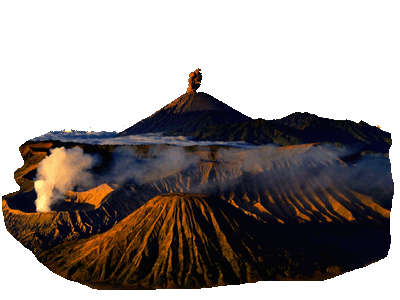
The 16-km-wide Tengger caldera is a volcanic complex that dates back to about 820,000 years ago and consists of five overlapping stratovolcanoes, each truncated by a caldera. Lava domes and pyroclastic cones occupy the flanks of the massif. This moon landscape is one of the coolest things you can see on this planet, preferably in the sunrise when the fog on the crater floor mixes up with the fresh rays of the sun.

Villa Spies

A young architect got the commission to design a summerhouse for the excentric billionaire Simon Spies, a hedonistic Dane with taste for women and good-life. The house is made out of reinforced plastic and is all white, a red remote control gives the owner access to the abundance of technology in the house. An elevator from the kitchen becomes a table in the living room and so on. Simon Spies subscribed to a Danish newspaper that where air dropped every day by plane for the cost of USD$ 1000 per day.

Il Gesù Ceiling

Il Gesu is the mother church of the Jesuits.Its facade recognized as "the first truly baroque façade" and it was the model for innumerable Jesuit churches all over the world, especially in the Americas. But it is the interior of the church that makes it among the masterpieces in the vd-guide. Giovanni Battista Gaulli's ceiling is a masterpiece of quadratura (architectural illusionism) combining stuccoed and painted figures and architecture.It is difficult to distinguish painted from stucco angels. The figural composition spill over the frame's edges which only heightens the illusion of the faithful rising miraculously toward the light above.

Notre Dame du Raincy

The Church is situated in the eastern Paris suburb Le Raincy. It was designed by the brothers Perret and built in 1922-1923, this was the first church to be built in reinforced concrete, and with no external ornamentation. the extraordinary feature with this church is the painted glass walls with concrete muntin. Many of the visitors to the church comes from Japan, as a smaller replica of Notre Dame du Raincy was built in the Tokyo suburbs.

Locust Plague

The 1915 locust plague, which lasted from March to October 1915, was a plague of locusts that stripped areas in and around Palestine of almost all vegetation. This invasion of awesome proportions seriously compromised the already-depleted food supply of the region and sharpened the misery of all Jerusalemites. Midhat Bay, who was the official appointed to fight the plague, helped enact a law which required every male between aged 15 and 60 in cities to collect 20 kilograms of locust eggs or pay a fine of £4.40. Research at Oxford University has identified that swarming behaviour is a response to overcrowding. Increased tactile stimulation of the hind legs causes an increase in levels of serotonin. This causes the locust to change color, eat much more, and breed much more easily. The transformation of the locust to the swarming variety is induced by several contacts per minute over a four-hour period. It is estimated that the largest swarms have covered hundreds of square miles and consisted of many billions of locusts.

Perito Moreno Glacier

The Perito Moreno Glacier is a glacier located in the Los Glaciares National Park in the south west of Santa Cruz province, Argentina. It is one of the most important tourist attractions in the Argentine Patagonia. The 250 km2 ice formation, and 30 km in length, is one of 48 glaciers fed by the Southern Patagonian Ice Field located in the Andes system shared with Chile. This icefield is the world's third largest reserve of fresh water.

Shwezigon Pagoda

Located near the modern village of Nyaung-U, Shwezigon was begun by Anawrahta (lower terraces), and completed by Kyanzittha in 1102. The zedi (stupa) is believed to enshrine one of four tooth relics of the Buddha that were brought over from Sri Lanka, and subsequently placed in four different stupas, to mark and consecrate the boundaries of Kyanzittha's royal city. The upper part of the stupa's anda (bell-shaped tower) was restored by King Bayinnaung in the 16th century. Shwezigon's shape was so well-liked that it greatly influenced the design of subsequent zedi in Burma.

Trellick Tower

Trellick Tower is a 31-storey block of flats in North Kensington London. It was designed in the Brutalist style by architect Ernö Goldfinger, after a commission from the Greater London Council in 1966, and completed in 1972. It is a Grade II listed Building and is 98 metres tall (120 metres including the communications mast). The Architect where perhaps even more Brutal then the Trellick Tower Building. Goldfinger was a serious man and sometimes fired his assistants if they were inappropriately jocular.

The "You Only Live Twice" Volcano

Spectre secret rocket base hidden in a hollow volcano One of the best super villain hiding places ever. From the James Bond movie "you only live twice". The exterior is from the japanese volcano "Kirishima". the inside set was constrcuted in England's Pinewood Studios, where an elaborate $1 million set was constructed

Devil's Swimming Pool


A famous feature of the Victoria Falls is a naturally formed pool known as the Devil's Pool, near the edge of the falls, accessed via Livingstone Island. When the river flow is at a safe level, usually during the months of September and December, people can swim as close as possible to the edge of the falls within the pool without continuing over the edge and falling into the gorge; this is possible due to a natural rock wall just below the water and at the very edge of the falls that stops their progress despite the current.

The Lightning Field

The Lightning Field by the American sculptor Walter De Maria, is a work of Land Art situated in a remote area of the high desert of southwestern New Mexico. It is comprised of 400 polished stainless steel poles installed in a grid array measuring one mile by one kilometer. The poles — five cm in diameter and averaging 7 meters in height—are spaced 70 meters apart and have solid pointed tips that define a horizontal plane. A sculpture to be walked in as well as viewed, The Lightning Field is intended to be experienced over an extended period of time, and visitors are encouraged to spend as much time as possible in it alone, especially during sunset and sunrise. In order to provide this opportunity, Dia offers overnight visits during the months of May through October.

The Weather Project


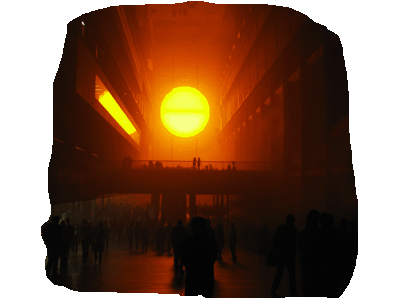
The weather project was installed at the London's Tate Modern in 2003 as part of the popular Unilever series. The installation filled the open space of the gallery's Turbine Hall. Eliasson used humidifiers to create a fine mist in the air via a mixture of sugar and water, as well as a semi-circular disc made up of hundreds of monochromatic lamps which radiated single frequency yellow light. The ceiling of the hall was covered with a huge mirror, in which visitors could see themselves as tiny black shadows against a mass of orange light. The work reportedly attracted two million visitors, many of whom were repeat customers

Guatemala Sinkholes


In February 2007, a large, deep circular hole with vertical walls opened in a poor neighborhood in northeast Guatemala city. This hole was 100 m deep, and was apparently created by fluid from a sewer eroding uncemented volcanic ash and other pyroclastic deposits underlying Guatemala City. The piping feature has since been mitigated and plans to develop on the site have been proposed. However, critics believe municipal authorities have neglected needed maintenance on the city's aging sewer system, and have speculated that more piping features ("sinkholes") are likely to develop unless action is taken. In May 2010, another piping feature, which was larger than a street intersection, developed after Tropical Storm Agatha. It engulfed a three story building and a house. No one was miraculous hurt. This 2010 piping feature was at least 18 m wide and 60 m deep.The distance between the 2010 piping feature and the 2007 piping feature three years ago is about two kilometers

Camp Topridge Boathouse

Great camps refer to the grandiose family compounds of cabins that were built in the latter half of the nineteenth century on lakes in the Adirondacks such as Spitfire Lake and Rainbow Lake. The camps were summer homes for the wealthy, where they could relax, host or attend parties, and enjoy the wilderness. In time, however, this was accomplished without leaving the comforts of civilization behind; some great camps even contained a bowling alley or movie theatre. Camp Topridge was built as the spectacular Adirondack retreat of Marjorie Merriweather Post, heiress to the Post cereal fortune. Constructed in 1923 by local builder, Ben Muncil, the exquisitely designed and massively proportioned main lodge elevated great camp architecture to magnificent new heights. Another masterpiece of Adirondack architecture, also built by Muncil, was the boathouse, which is noted for its extraordinary detailing of tree limbs and roots. From the boathouse, guests were transported up hill to the main lodge on a funicular, or small cable car, one of Topridge's most innovative and luxurious features. The main boathouse at Topridge, with its curving cedar railings and twig work screens, is one of the major and last examples of the naturalistic rustic tradition.

Dubai Islands

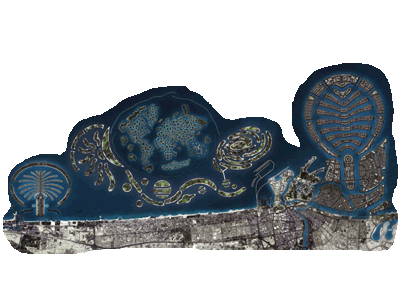
The Dubai Islands (The palm trees and The world) are artificial peninsulas constructed of sand dredged from the bottom of the Persian Gulf. The sand is sprayed by the dredging ships, which are guided by DGPS, onto the required area in a process known as rainbowing because of the arcs in the air when the sand is sprayed. There are three artificial landmasses looking like palm trees, there are also an archipelago of islands that are created to mimic the earth from above.

Nagshe Rostam

Four tombs belonging to Achaemenid kings are carved out of the rock face. They are all at a considerable height above the ground. The tombs are known locally as the 'Persian crosses', after the shape of the facades of the tombs. The site is known as salīb in Arabic, perhaps a corruption of the Persian word chalīpā, "cross". The entrance to each tomb is at the center of each cross, which opens onto to a small chamber, where the king lay in a sarcophagus. The horizontal beam of each of the tomb's facades is believed to be a replica of the entrance of the palace at Persepolis. One of the tombs is explicitly identified by an accompanying inscription to be the tomb of Darius I (r. 522-486 BC). The other three tombs are believed to be those of Xerxes I (r. 486-465 BC), Artaxerxes I (r. 465-424 BC), and Darius II (r. 423-404 BC) respectively. A fifth unfinished one might be that of Artaxerxes III, who reigned at the longest two years, but is more likely that of Darius III (r. 336-330 BC), last of the Achaemenid dynasts. The tombs were looted following the conquest of the Achaemenid empire by Alexander the Great.

Nazi Forest

The forest swastika was a patch of larch trees covering 3,600 m2 (4,300 sq yd) area of pine forest near Zernikow, Uckermark district, Brandenburg, in northeastern Germany, carefully arranged to look like a swastika. It was probably planted near the height of Hitler's power, in the 1930s. is unclear how the trees came to be planted and arranged thus. It has been suggested that it was laid out in 1937 by locals to prove their loyalty after a businessman in the area was denounced and sent to a concentration camp by the Nazi Party for listening to the BBC. Another theory is that a zealous forester convinced local Hitler Youth members to plant the trees in commemoration of Adolf Hitler's birthday.One source maintains it was planted by a warden, either out of support for the Hitler regime, or due to an order from state officials. For a few weeks every year in the autumn and in the spring, the colour of the larch leaves would change, contrasting with the deep green of the pine forest.The short duration of the effect combined with the fact that the image could only be discerned from the air and the relative scarcity of privately owned aeroplanes in the area meant that the swastika went largely unnoticed after the fall of the Nazi Party. During the subsequent Communist period, Communist authorities reportedly knew of its existence but made no effort to remove it.However, in 1992, the reunified German government ordered aerial surveys of all state-owned land. The photographs were examined by forestry students, who immediately noticed the design.

Rapla Administrative Building

It was difficult to find information on this strange piece of architecture. We found an estonian webpage which we tried to translate, but the result was peculiar. Link to site: http://www.epl.ee/artikkel/575178 However, we like the overall design.

State Capitol Bank

Originally the flying saucers appeared to hover above the building as seen below. All the glass that made that effect possible also made heating and cooling an expensive proposition. Security concerns also mandated replacement of those windows with solid materials and small square portholes. It is equipped with a floating air lobby from the main floor to the lower floor, and a cashier to customer TV drive-in banking window.

Teotihuacan

Teotihuacan is an enormous archaeological site in the Basin of Mexico, containing some of the largest pyramidal structures built in the pre-Columbian Americas. Apart from the pyramidal structures, Teotihuacan is also known for its large residential complexes, the Avenue of the Dead, and numerous colorful, well-preserved murals. Teotihuacan was the largest city in the pre-Columbian Americas. At this time it may have had more than 200,000 inhabitants, placing it among the largest cities of the world in this period. The city's broad central avenue, called "Avenue of the Dead" is flanked by impressive ceremonial architecture, including the immense Pyramid of the Sun (second largest in the New World after the Great Pyramid of Cholula) and the Pyramid of the Moon. Along the Avenue of the Dead are many smaller talud-tablero platforms. The Aztecs believed they were tombs, inspiring the name of the avenue. Now scholars have established these were ceremonial platforms that were topped with temples.

Train Churches

Russia has a number of churches housed in railway cars. Railway car churches have been around for quite a while, when they were used to reach out to growing settlements and towns via train, instead of investing in building a church. These “Cathedral Cars” slowly moved out, but apparently, they stayed in Russia and are doing well in their own way. The rail tracks may have moved, and these churches are stationary now.

Wave Rock Arizona

The Wave is made of Jurassic-age Navajo Sandstone that is approximately 190 million years old. Scientists who study The Wave say that the old sand dunes turned into hard compacted rock over the ages, calcifying in vertical and horizontal layers.[1] Erosion by wind and rain has created the spectacular landscape which appears now. The soft sandstone of The Wave is fragile, one needs to walk carefully to not break the small ridges. A good time for photographing The Wave is the few hours around midday when there are no shadows in the center, although early morning and late afternoon shadows can also make for dramatic photos. After a recent rain storm, numerous pools form which can contain hundreds of tadpoles and fairy shrimp. These pools can be present for several days.

Villa Girasole

Villa Girasole has an upper section that rests on a circular track and follows the sun, 1,500 tons powered by two motors with a total of three horsepower. The two storied and L shaped house rests on a circular base, which is over 44 meters in diameter. In the middle there is a 42 meters tall turret, a sort of conning tower or lighthouse, which the rotating movement hinges on. A diesel engine pushes the house over three circular tracks where 15 trolleys can slide the 5,000 cubic meters building at a speed of 4 millimeters per second (it takes 9 hours and 20 minutes to rotate fully). The engineer was thinking of the sun’s path, of a relation with landscape and the space of human’s life. He ventured to hope that the new construction breakthroughs would free mankind from the heaviness of traditional techniques and from the burden of history. “Without risk there can be no possibility of success” said the architect.

Pages