The Sacred Mosque of Mecca

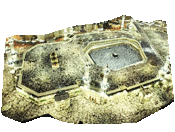
The Sacred Mosque, is the largest mosque in the world. Located in the city of Mecca, it surrounds the Kaaba, the place which Muslims turn towards while offering daily prayers and is considered to be the holiest place on Earth by Muslims. The current structure covers an area of 356,800 square meters including the outdoor and indoor praying spaces and can accommodate up to 4 million worshippers during the Hajj period.Islamic tradition holds that the mosque was first built by the angels before the creation of mankind. The Black Stone is situated near the eastern corner of the Kaaba, and according to some people is believed to have 'fallen from heaven' and turned black due to man's misdeeds.

Rudin House

The exterior shape of the house might be seen as a prototypical house. A sloping roof, a tall chimney and large windows remind one of a child’s drawing. The tar-board roof and the unfinished concrete facades flow almost seamlessly into one another without an overhang. The simple monolithic building is exposed to wind and weather; rainwater runs down it as it would run down a boulder. The unfinished concrete walls of the façades emphasize the weight and materiality of the building, but being raised off the ground as if on stilts lightens its appearance. The projecting decks at the sides of the house reinforce this image of lightness and of suspension over the landscape. Fruit trees and meadows underline the agricultural character of the garden that is barely distinguishable from the surrounding landscape. The interior of the house is characterized by contrasting spatial qualities and materials, such as concrete, adobe, and colors such as silver and pink. The staircase which reaches up to the roof is especially spectacular.

Darvaza Gas Crater

In the hot, expansive Karakum desert in Turkmenistan, near the 350 person village of Derweze, is a hole 100 meters wide that has been on fire, continuously, for 38 years. Known as the Darvaza Gas Crater or the "Gate to Hell" by locals, the crater can be seen glowing for kilometers around. The hole is the outcome not of nature but of an industrial accident. In 1971 a Soviet drilling rig accidentally punched into a massive underground natural gas cavern, causing the ground to collapse and the entire drilling rig to fall in. Having punctured a pocket of gas, poisonous fumes began leaking from the hole at an alarming rate. To head off a potential environmental catastrophe, the Soviets set the hole alight. The crater hasn't stopped burning since.

Salar de Uyuni

The Salar de Uyuni, a sea of salt, a salt desert, in southwestern Bolivia, was once an inland sea, or giantsalt water lake, but the water vanished into the thin dry air of Andean altitude. All that remains is the salt, tens of meters thick, lying stark beneath bright sky: a sun-bleached skeleton of a dead sea.

Il Cretto

An earthquake shook the western edge of Sicily in the Belice river valley. Gibellina was among twelve towns completely destroyed, though rebuilding happened differently here than in other towns. Instead of building atop the ruins of the old town the Gibellina was built approximately 20 km away, near a train line and highway. In 1981 Burri visited Gibellina, proposing the massive Cretto over the ruins of the old town.

Surrounded Islands

In 1983, eleven of the islands situated in Biscayne Bay, Greater Miami, were surrounded with 6.5 million square feet (603,870 square meters) of floating pink woven polypropylene fabric covering the surface of the water and extending out from each island into the bay.

Honghe Rice Terraces

On the banks of Honghe River in South China's Yunnan Province are millions of acres of agricultural and ecological wonders - otherwise known as the Honghe Hani Terrace. Making full use of the special geological and climactic conditions in the area, the Hani people have found a perfect combination between human civilization and the environment. In terms of size and coverage, the Hani Terrace is largest in the world. The Hani People, creators of this wonder, originated from the Tibetan Plateau on the upper reaches of the Yellow River. After centuries of migration, a group of the ancient Qiang people settled down in the Ailao Mountains in Southern Yunnan, and became today's Hani race. About 600,000 Hani people still dwell in the region and their ancestors totally altered the landforms there to grow crops to feed themselves, yet the ecology was not damaged. In fact, they have made the place even more attractive, presenting a perfect testimony to harmony between man and nature. The terrace shows that human intervention doesn't necessarily mean destroying nature.

Lake Moraine

Moraine Lake is a glacially fed lake in Banff National Park, 14 kilometres outside the Village of Lake Louise, Alberta, Canada. It is situated in the Valley of the Ten Peaks, at an elevation of approximately 1,885 m. The lake has a surface area of 0.5 square kilometres. The lake, being glacially fed, does not reach its crest until mid to late June. When it is full, it reflects a distinct shade of blue. The color is due to the refraction of light off the rock flour deposited in the lake on a continual basis. Moraine Lake is well known for the multitude of grizzlies that inhabit the surrounding valley. For this reason, the park may require you to hike in groups of six, and may occasionally close off trails completely.

Jellyfish Lake

Jellyfish Lake is one of Palau's most famous dive (snorkeling only) sites. It is notable for the millions of golden jellyfish which migrate horizontally across the lake daily. Jellyfish Lake is connected to the ocean through fissures and tunnels in the limestone of ancient Miocene reef. However the lake is sufficiently isolated and the conditions are different enough that the diversity of species in the lake is greatly reduced from the nearby lagoon. The golden jellyfish in the lake have evolved to be substantially different from their close relatives living in the nearby lagoons.

Wigwam Motels

The Wigwam Motels, also known as the "Wigwam Villages", is a motel chain in the United States in which the rooms are built in the form of teepees, hence the name "wigwam". It originally had seven different locations: two locations in Kentucky, a location in Alabama, another location in Florida, one in Arizona, one in Louisiana, and another one in California. They are very distinctive historic landmarks. Two of the three surviving motels are located on historic U.S. Route 66, in Holbrook, Arizona and on the city boundary between Rialto and San Bernardino, California. Wigwam Village no 6 in Holbrook was built in 1950 by Arizona motel owner Chester E. Lewis, the plans were based on the original of Frank A. Redford. Lewis first became aware of the distinctive wigwam designs when he was passing through Cave City in 1938. He purchased the rights to Redford's design, as well as the right to use the name "Wigwam Village" in a novel royalty agreement: coin operated radios would be installed in Lewis' Wigwam Village, and every dime inserted for 30 minutes of play would be sent to Redford as payment.

San Zhi Resort

This little resort area in sanzhai was build by local contractors commissioned by the government, but a series of work related accidents left people dead, and pretty soon the whole country considered it haunted. now its abandoned, but they won't demolish it because destroying the home of spirits is serious taboo.

Sossusvlei

Some of the spectacular hills of sand are, at a height of 300 metres, the highest in the world.

The Money Bin

he Money Bin is a three-cubic-acre building where Scrooge McDuck stores the portions of his money that he earned by himself. It was originally featured in the Uncle Scrooge comic book stories created by Carl Barks.

Mayon Volcano

550 kilometers from Manila, rises a near perfect cone volcano; the famous Mayon Volcano. Its symmetrical form at any horizontal direction makes this volcano a truly scenic wonder.

Robie House

Robie House was designed and built between 1908 and 1910 by architect Frank Lloyd Wright and is renowned as the greatest example of the Prairie School style, the first architectural style that was uniquely American. The term was coined by architectural critics and historians (not by Wright) who noticed how the buildings and their various components owed their design influence to the landscape and plant life of the midwest prairie of the United States. Typical of Wright's Prairie houses, he designed not only the house, but all of the interiors, the windows, lighting, rugs, furniture and textiles. As Wright wrote in 1910, "it is quite impossible to consider the building one thing and its furnishings another. ... They are all mere structural details of its character and completeness."

Rietveld Schroder House

The Rietveld Schröder House constitutes both inside and outside a radical break with all architecture before it. The two-story house is situated in Utrecht, at the end of a terrace, but it makes no attempt to relate to its neighbouring buildings (although it shares an exterior wall with the last house in the terrace). It faces a motorway built in the 1960s. Inside there is no static accumulation of rooms, but a dynamic, changeable open zone. The ground floor can still be termed traditional; ranged around a central staircase are kitchen and three sit/bedrooms. The living area upstairs, stated as being an attic to satisfy the fire regulations of the planning authorities, in fact forms a large open zone except for a separate toilet and a bathroom. Rietveld wanted to leave the upper level as it was. Mrs Schröder, however, felt that as living space it should be usable in either form, open or subdivided. This was achieved with a system of sliding and revolving panels. Mrs Schröder used these panels to open up the space of the second floor to allow more of an open area for her and her 3 children, leaving the option still of closing or separating the rooms when desired. When entirely partitioned in, the living level comprises three bedrooms, bathroom and living room. In-between this and the open state is a wide variety of possible permutations, each providing its own spatial experience.

Black Rock City

Burning Man is an annual gathering that takes place at Black Rock City—a temporary community erected in the Black Rock Desert in Nevada. The event is described as an experiment in community and art, influenced by 10 main principles, including "radical" inclusion, self-reliance and self-expression, as well as community cooperation, gifting and decommodification, and leaving no trace. First held in 1986 on Baker Beach in San Francisco as a small function organized by Larry Harvey and a group of friends, it has since been held annually. 1997 marked another major pivotal year for the event. By 1996, the event had grown to 8,000 attendees and unrestricted driving on the open playa was becoming a major safety hazard. To implement a ban on driving and re-create the event as a pedestrian/bicycle/art-car-only event, it was decided to move to private gated property. Fly Ranch, with the adjoining Hualapai mini dry lake-bed, just west of the Black Rock desert, was chosen. This moved Burning Man from Pershing county/federal BLM land into the jurisdiction of Washoe County, which brought a protracted list of permit requirements. To comply with the new requirements and to manage the increased liability load, the organizers formed Black Rock City, LLC. Will Roger Peterson and Flynn Mauthe created the Department of Public Works (DPW) to build the "city" grid layout (a requirement so that emergency vehicles could be directed to an "address") designed by Rod Garrett, an architect. Rod continued as the city designer through 2011 until his death at 76. He is also credited with the design of all of the man bases from 2001 through 2012, the center camp cafe and first camp. With the success of the driving ban, having no vehicular incidents, 1998 saw a return to the Black Rock desert, along with a temporary perimeter fence. The event has remained there since.
Pages