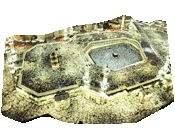
The Sacred Mosque of Mecca

The Sacred Mosque, is the largest mosque in the world. Located in the city of Mecca, it surrounds the Kaaba, the place which Muslims turn towards while offering daily prayers and is considered to be the holiest place on Earth by Muslims. The current structure covers an area of 356,800 square meters including the outdoor and indoor praying spaces and can accommodate up to 4 million worshippers during the Hajj period.Islamic tradition holds that the mosque was first built by the angels before the creation of mankind. The Black Stone is situated near the eastern corner of the Kaaba, and according to some people is believed to have 'fallen from heaven' and turned black due to man's misdeeds.

Rudin House

The exterior shape of the house might be seen as a prototypical house. A sloping roof, a tall chimney and large windows remind one of a child’s drawing. The tar-board roof and the unfinished concrete facades flow almost seamlessly into one another without an overhang. The simple monolithic building is exposed to wind and weather; rainwater runs down it as it would run down a boulder. The unfinished concrete walls of the façades emphasize the weight and materiality of the building, but being raised off the ground as if on stilts lightens its appearance. The projecting decks at the sides of the house reinforce this image of lightness and of suspension over the landscape. Fruit trees and meadows underline the agricultural character of the garden that is barely distinguishable from the surrounding landscape. The interior of the house is characterized by contrasting spatial qualities and materials, such as concrete, adobe, and colors such as silver and pink. The staircase which reaches up to the roof is especially spectacular.

Darvaza Gas Crater

In the hot, expansive Karakum desert in Turkmenistan, near the 350 person village of Derweze, is a hole 100 meters wide that has been on fire, continuously, for 38 years. Known as the Darvaza Gas Crater or the "Gate to Hell" by locals, the crater can be seen glowing for kilometers around. The hole is the outcome not of nature but of an industrial accident. In 1971 a Soviet drilling rig accidentally punched into a massive underground natural gas cavern, causing the ground to collapse and the entire drilling rig to fall in. Having punctured a pocket of gas, poisonous fumes began leaking from the hole at an alarming rate. To head off a potential environmental catastrophe, the Soviets set the hole alight. The crater hasn't stopped burning since.

Salar de Uyuni

The Salar de Uyuni, a sea of salt, a salt desert, in southwestern Bolivia, was once an inland sea, or giantsalt water lake, but the water vanished into the thin dry air of Andean altitude. All that remains is the salt, tens of meters thick, lying stark beneath bright sky: a sun-bleached skeleton of a dead sea.

Il Cretto

An earthquake shook the western edge of Sicily in the Belice river valley. Gibellina was among twelve towns completely destroyed, though rebuilding happened differently here than in other towns. Instead of building atop the ruins of the old town the Gibellina was built approximately 20 km away, near a train line and highway. In 1981 Burri visited Gibellina, proposing the massive Cretto over the ruins of the old town.

Surrounded Islands

In 1983, eleven of the islands situated in Biscayne Bay, Greater Miami, were surrounded with 6.5 million square feet (603,870 square meters) of floating pink woven polypropylene fabric covering the surface of the water and extending out from each island into the bay.

Honghe Rice Terraces

On the banks of Honghe River in South China's Yunnan Province are millions of acres of agricultural and ecological wonders - otherwise known as the Honghe Hani Terrace. Making full use of the special geological and climactic conditions in the area, the Hani people have found a perfect combination between human civilization and the environment. In terms of size and coverage, the Hani Terrace is largest in the world. The Hani People, creators of this wonder, originated from the Tibetan Plateau on the upper reaches of the Yellow River. After centuries of migration, a group of the ancient Qiang people settled down in the Ailao Mountains in Southern Yunnan, and became today's Hani race. About 600,000 Hani people still dwell in the region and their ancestors totally altered the landforms there to grow crops to feed themselves, yet the ecology was not damaged. In fact, they have made the place even more attractive, presenting a perfect testimony to harmony between man and nature. The terrace shows that human intervention doesn't necessarily mean destroying nature.

Lake Moraine

Moraine Lake is a glacially fed lake in Banff National Park, 14 kilometres outside the Village of Lake Louise, Alberta, Canada. It is situated in the Valley of the Ten Peaks, at an elevation of approximately 1,885 m. The lake has a surface area of 0.5 square kilometres. The lake, being glacially fed, does not reach its crest until mid to late June. When it is full, it reflects a distinct shade of blue. The color is due to the refraction of light off the rock flour deposited in the lake on a continual basis. Moraine Lake is well known for the multitude of grizzlies that inhabit the surrounding valley. For this reason, the park may require you to hike in groups of six, and may occasionally close off trails completely.

Jellyfish Lake

Jellyfish Lake is one of Palau's most famous dive (snorkeling only) sites. It is notable for the millions of golden jellyfish which migrate horizontally across the lake daily. Jellyfish Lake is connected to the ocean through fissures and tunnels in the limestone of ancient Miocene reef. However the lake is sufficiently isolated and the conditions are different enough that the diversity of species in the lake is greatly reduced from the nearby lagoon. The golden jellyfish in the lake have evolved to be substantially different from their close relatives living in the nearby lagoons.

Wigwam Motels

The Wigwam Motels, also known as the "Wigwam Villages", is a motel chain in the United States in which the rooms are built in the form of teepees, hence the name "wigwam". It originally had seven different locations: two locations in Kentucky, a location in Alabama, another location in Florida, one in Arizona, one in Louisiana, and another one in California. They are very distinctive historic landmarks. Two of the three surviving motels are located on historic U.S. Route 66, in Holbrook, Arizona and on the city boundary between Rialto and San Bernardino, California. Wigwam Village no 6 in Holbrook was built in 1950 by Arizona motel owner Chester E. Lewis, the plans were based on the original of Frank A. Redford. Lewis first became aware of the distinctive wigwam designs when he was passing through Cave City in 1938. He purchased the rights to Redford's design, as well as the right to use the name "Wigwam Village" in a novel royalty agreement: coin operated radios would be installed in Lewis' Wigwam Village, and every dime inserted for 30 minutes of play would be sent to Redford as payment.

San Zhi Resort

This little resort area in sanzhai was build by local contractors commissioned by the government, but a series of work related accidents left people dead, and pretty soon the whole country considered it haunted. now its abandoned, but they won't demolish it because destroying the home of spirits is serious taboo.

Sossusvlei

Some of the spectacular hills of sand are, at a height of 300 metres, the highest in the world.

The Money Bin

he Money Bin is a three-cubic-acre building where Scrooge McDuck stores the portions of his money that he earned by himself. It was originally featured in the Uncle Scrooge comic book stories created by Carl Barks.

Mayon Volcano

550 kilometers from Manila, rises a near perfect cone volcano; the famous Mayon Volcano. Its symmetrical form at any horizontal direction makes this volcano a truly scenic wonder.

Robie House

Robie House was designed and built between 1908 and 1910 by architect Frank Lloyd Wright and is renowned as the greatest example of the Prairie School style, the first architectural style that was uniquely American. The term was coined by architectural critics and historians (not by Wright) who noticed how the buildings and their various components owed their design influence to the landscape and plant life of the midwest prairie of the United States. Typical of Wright's Prairie houses, he designed not only the house, but all of the interiors, the windows, lighting, rugs, furniture and textiles. As Wright wrote in 1910, "it is quite impossible to consider the building one thing and its furnishings another. ... They are all mere structural details of its character and completeness."

Rietveld Schroder House

The Rietveld Schröder House constitutes both inside and outside a radical break with all architecture before it. The two-story house is situated in Utrecht, at the end of a terrace, but it makes no attempt to relate to its neighbouring buildings (although it shares an exterior wall with the last house in the terrace). It faces a motorway built in the 1960s. Inside there is no static accumulation of rooms, but a dynamic, changeable open zone. The ground floor can still be termed traditional; ranged around a central staircase are kitchen and three sit/bedrooms. The living area upstairs, stated as being an attic to satisfy the fire regulations of the planning authorities, in fact forms a large open zone except for a separate toilet and a bathroom. Rietveld wanted to leave the upper level as it was. Mrs Schröder, however, felt that as living space it should be usable in either form, open or subdivided. This was achieved with a system of sliding and revolving panels. Mrs Schröder used these panels to open up the space of the second floor to allow more of an open area for her and her 3 children, leaving the option still of closing or separating the rooms when desired. When entirely partitioned in, the living level comprises three bedrooms, bathroom and living room. In-between this and the open state is a wide variety of possible permutations, each providing its own spatial experience.

Black Rock City

Burning Man is an annual gathering that takes place at Black Rock City—a temporary community erected in the Black Rock Desert in Nevada. The event is described as an experiment in community and art, influenced by 10 main principles, including "radical" inclusion, self-reliance and self-expression, as well as community cooperation, gifting and decommodification, and leaving no trace. First held in 1986 on Baker Beach in San Francisco as a small function organized by Larry Harvey and a group of friends, it has since been held annually. 1997 marked another major pivotal year for the event. By 1996, the event had grown to 8,000 attendees and unrestricted driving on the open playa was becoming a major safety hazard. To implement a ban on driving and re-create the event as a pedestrian/bicycle/art-car-only event, it was decided to move to private gated property. Fly Ranch, with the adjoining Hualapai mini dry lake-bed, just west of the Black Rock desert, was chosen. This moved Burning Man from Pershing county/federal BLM land into the jurisdiction of Washoe County, which brought a protracted list of permit requirements. To comply with the new requirements and to manage the increased liability load, the organizers formed Black Rock City, LLC. Will Roger Peterson and Flynn Mauthe created the Department of Public Works (DPW) to build the "city" grid layout (a requirement so that emergency vehicles could be directed to an "address") designed by Rod Garrett, an architect. Rod continued as the city designer through 2011 until his death at 76. He is also credited with the design of all of the man bases from 2001 through 2012, the center camp cafe and first camp. With the success of the driving ban, having no vehicular incidents, 1998 saw a return to the Black Rock desert, along with a temporary perimeter fence. The event has remained there since.
Tindaya Project

Mount Tindaya is located on Fuerteventura in the Canary Islands. It was chosen by artist Eduardo Chillida, after a long and exhaustive search, as the location for a large-scale sculpture, a carved space of roughly cubic proportions (50m per side) inside the mountain that would be capped by two skylights.The three-phase project (I-feasibility, II-drilling, III-construction) is expected to be completed in 2015

The Roden Crater Project


"I wanted to use the very fine qualities of light. First of all, moonlight. There's a space where you can see your shadow from the light of Venus alone—things like this. I also wanted to gather starlight that was from outside the planetary system, which would be from the sun or reflected off of the moon or a planet...you've got this older light that's away from the light even of our galaxy. So that is light that would be at least three and a half billion years old. So you're gathering light that's older than our solar system."

Pepsi Pavillion

E.A.T.'s ambition was to create a laboratory environment, encouraging ‹live programming› that offered opportunity for experimentation, rather than resort to fixed or ‹dead programming›, typical of most exposition pavilions. The Pavilion‘s interior dome –immersing viewers in three-dimensional real images generated by mirror reflections, as well as spatialized electronic music–invited the spectator to individually and collectively participate in the experience.The pavilion also emits thick vapour, three decades before the blur-building.

Waw an Namus

Waw an Namus is an exotic volcano deep in the desert of Libya. A low caldera about 4 km in diameter is surrounded by a 5 - 10 km wide dark black deposit of ash that stands out starkly against the yellowish desert. The few people who have visited have been struck by its beauty: The Italian geologist Angelo Pesce wrote that as seen from the rim, one is "overwhelmed by a scene of rare beauty....Inside, the only thing one wishess is to be alone and wander in admiration from one end to the other."

Casa del Puente

An elegant single-story exposed concrete house in the seaside town of Mar del Plata, it was built in 1942 by Amancio Williams for his father. Supported by a sweeping arch over a stream, the house was innovative for its free plan, fenestration and daring use of materials. Now a national landmark, sadly it is currently in very poor condition.

Chocolate Hills

The Chocolate Hills is an unusual geological formation in Bohol, Philippines. It is composed of around 1,268 perfectly cone-shaped hills of about the same size, spread over an area of more than 50 square kilometres. They are covered in green grass that turns brown during the dry season, hence the name.

Dom Bosco

There are 80 16m-high columns in Brise-Soleil closing in Gothic style, with stained-glass windows in 12 shades of blue, symbolizing a starry sky. The central luster by Alvimar Moreira contains 7.400 Murano glasses and 180 lamps weighing 2.600 kg.

Lichtdom

As part of their campaign to unify the German people behind Nazi ideals, Hitler enouraged his architects, especially Albert Speer, to create places for Germans to have what he termed "mass experiences." To do this, they created assembly halls, stadia, and assembly grounds where thousands could gather to display their patriotism and be edified by the speeches of party leaders. The most significant of these places was the Zeppelin Field at Nuremburg, where the Nazi Party held annual rallies celebrating the anniversaries of its formation in 1920 and the 1923 Beer Hall Putsch. The Zeppelintribune was the centerpiece of the Nuremburg party monuments. It incorporated classical elements, but modified them to emphasize line, cleanliness, and order. From this building, Hitler and other party leaders gave speeches to assemblies of tens of thousands of germans. The most effective part of this assembly grounds was not the building, but the light. Speer surrounded the assembly area with hundreds of spotlights pointed skywards. The effect was to create a "cathedral of light," a Lichtdom, and its impact was tremendous.

White and Pink Terraces

They were known as the eighth wonder of the world - glistening pink and white terraces of silica, created by the warmth from the centre of the earth.Cascading into the remote Lake Rotomahana, people from all over the world travelled by steam ship, then horse and cart, a two-hour canoe journey and finally on foot to see nature’s masterpiece.In 1886, the terraces were destroyed when Mt Tarawera erupted, devastating most of the surrounding landscape, and killing more than 150 people.

Druzhba Sanatorium

The resort building’s cylindrical form stands on a hill overlooking a beach in what was then an exclusive resort town. To enter, visitors cross a bridge encased in a glass tube and then descend into the complex, which is supported on massive legs housing the elevators and stairs. Conceived as a “social condenser,” the building’s core is occupied by a cinema, dance hall, swimming pool and cafe. Circling this core are the guest rooms, arrayed in a dazzling saw-tooth facade orienting each room toward the water and sunlight, while giving the structure an eerie science-fiction quality.

Kaiteur Falls

Kaieteur Falls is about five times higher than the Niagara Falls and about two times the height of the Victoria Falls.It is 226 meters when measured from its plunge over a sandstone cliff to the first break.Its distinction lies in the unique combination of great height and large volume, averaging 663 cubic meters per second, combined with a dramatic setting in the jungle.

Lake Nakuru

Lake Nakuru is one of the Rift Valley soda lakes. It lies to the south of Nakuru, in central Kenya.The lake's abundance of algae attracts the vast quantity of flamingos that famously lines the shore, up to 1.5 million have been seen at a time.

Lingotto Factory

Built from 1916 and opened in 1923, the design was unusual in that it had five floors, with raw materials going in at the ground floor, and cars built on a line that went up through the building. Finished cars emerged at rooftop level, where there was a rooftop test track. It was the largest car factory in the world at that time. For its time, the Lingotto building was avante-garde, influential and impressive—Le Corbusier called it "one of the most impressive sights in industry", and "a guideline for town planning". The factory became outdated in the 70s and where remodeled into a cultural centre.

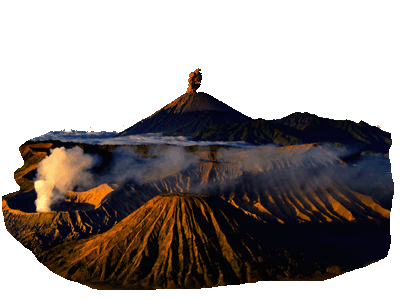
Tengger Caldera

The 16-km-wide Tengger caldera is a volcanic complex that dates back to about 820,000 years ago and consists of five overlapping stratovolcanoes, each truncated by a caldera. Lava domes and pyroclastic cones occupy the flanks of the massif. This moon landscape is one of the coolest things you can see on this planet, preferably in the sunrise when the fog on the crater floor mixes up with the fresh rays of the sun.

Villa Spies

A young architect got the commission to design a summerhouse for the excentric billionaire Simon Spies, a hedonistic Dane with taste for women and good-life. The house is made out of reinforced plastic and is all white, a red remote control gives the owner access to the abundance of technology in the house. An elevator from the kitchen becomes a table in the living room and so on. Simon Spies subscribed to a Danish newspaper that where air dropped every day by plane for the cost of USD$ 1000 per day.

Il Gesù Ceiling

Il Gesu is the mother church of the Jesuits.Its facade recognized as "the first truly baroque façade" and it was the model for innumerable Jesuit churches all over the world, especially in the Americas. But it is the interior of the church that makes it among the masterpieces in the vd-guide. Giovanni Battista Gaulli's ceiling is a masterpiece of quadratura (architectural illusionism) combining stuccoed and painted figures and architecture.It is difficult to distinguish painted from stucco angels. The figural composition spill over the frame's edges which only heightens the illusion of the faithful rising miraculously toward the light above.

Notre Dame du Raincy

The Church is situated in the eastern Paris suburb Le Raincy. It was designed by the brothers Perret and built in 1922-1923, this was the first church to be built in reinforced concrete, and with no external ornamentation. the extraordinary feature with this church is the painted glass walls with concrete muntin. Many of the visitors to the church comes from Japan, as a smaller replica of Notre Dame du Raincy was built in the Tokyo suburbs.

Locust Plague

The 1915 locust plague, which lasted from March to October 1915, was a plague of locusts that stripped areas in and around Palestine of almost all vegetation. This invasion of awesome proportions seriously compromised the already-depleted food supply of the region and sharpened the misery of all Jerusalemites. Midhat Bay, who was the official appointed to fight the plague, helped enact a law which required every male between aged 15 and 60 in cities to collect 20 kilograms of locust eggs or pay a fine of £4.40. Research at Oxford University has identified that swarming behaviour is a response to overcrowding. Increased tactile stimulation of the hind legs causes an increase in levels of serotonin. This causes the locust to change color, eat much more, and breed much more easily. The transformation of the locust to the swarming variety is induced by several contacts per minute over a four-hour period. It is estimated that the largest swarms have covered hundreds of square miles and consisted of many billions of locusts.

Perito Moreno Glacier

The Perito Moreno Glacier is a glacier located in the Los Glaciares National Park in the south west of Santa Cruz province, Argentina. It is one of the most important tourist attractions in the Argentine Patagonia. The 250 km2 ice formation, and 30 km in length, is one of 48 glaciers fed by the Southern Patagonian Ice Field located in the Andes system shared with Chile. This icefield is the world's third largest reserve of fresh water.

Shwezigon Pagoda

Located near the modern village of Nyaung-U, Shwezigon was begun by Anawrahta (lower terraces), and completed by Kyanzittha in 1102. The zedi (stupa) is believed to enshrine one of four tooth relics of the Buddha that were brought over from Sri Lanka, and subsequently placed in four different stupas, to mark and consecrate the boundaries of Kyanzittha's royal city. The upper part of the stupa's anda (bell-shaped tower) was restored by King Bayinnaung in the 16th century. Shwezigon's shape was so well-liked that it greatly influenced the design of subsequent zedi in Burma.

Trellick Tower

Trellick Tower is a 31-storey block of flats in North Kensington London. It was designed in the Brutalist style by architect Ernö Goldfinger, after a commission from the Greater London Council in 1966, and completed in 1972. It is a Grade II listed Building and is 98 metres tall (120 metres including the communications mast). The Architect where perhaps even more Brutal then the Trellick Tower Building. Goldfinger was a serious man and sometimes fired his assistants if they were inappropriately jocular.

The "You Only Live Twice" Volcano

Spectre secret rocket base hidden in a hollow volcano One of the best super villain hiding places ever. From the James Bond movie "you only live twice". The exterior is from the japanese volcano "Kirishima". the inside set was constrcuted in England's Pinewood Studios, where an elaborate $1 million set was constructed

Devil's Swimming Pool


A famous feature of the Victoria Falls is a naturally formed pool known as the Devil's Pool, near the edge of the falls, accessed via Livingstone Island. When the river flow is at a safe level, usually during the months of September and December, people can swim as close as possible to the edge of the falls within the pool without continuing over the edge and falling into the gorge; this is possible due to a natural rock wall just below the water and at the very edge of the falls that stops their progress despite the current.

The Lightning Field

The Lightning Field by the American sculptor Walter De Maria, is a work of Land Art situated in a remote area of the high desert of southwestern New Mexico. It is comprised of 400 polished stainless steel poles installed in a grid array measuring one mile by one kilometer. The poles — five cm in diameter and averaging 7 meters in height—are spaced 70 meters apart and have solid pointed tips that define a horizontal plane. A sculpture to be walked in as well as viewed, The Lightning Field is intended to be experienced over an extended period of time, and visitors are encouraged to spend as much time as possible in it alone, especially during sunset and sunrise. In order to provide this opportunity, Dia offers overnight visits during the months of May through October.

Pages